|
1. 检查cinder当前backend配置 使用cinder service-list,查看cinder-volume服务的Host字段格式。 旧版格式: 
新版格式: 
旧版中Host字段是cinder-volume服务所在节点的HOSTNAME,新版中Host字段是HOSTNAME@BACKEND。 如果是旧版,需要先修改为新版,见步骤2。 如果是新版,不需要修改,直接执行步骤3。 : ~% S; Z+ L3 W# `6 Z/ ^6 N! \
2. 修改旧版backend配置为新版 编辑/etc/cinder/cinder.conf文件,删除其中原有的ceph backend相关配置: [DEFAULT]rbd_store_chunk_size = 4rbd_max_clone_depth = 5rbd_flatten_volume_from_snapshot = truerbd_ceph_conf = /etc/ceph/ceph2.confrbd_pool = volumesrados_connect_timeout = -1volume_driver = cinder.volume.drivers.rbd.RBDDriver% `9 T: M/ o- B1 |7 d
添加如下配置: [DEFAULT]enabled_backends = ceph2[ceph2]rbd_pool = volumes (cephpool-name)rbd_ceph_conf = /etc/ceph/ceph2.confrbd_flatten_volume_from_snapshot = truerbd_max_clone_depth = 5rbd_store_chunk_size = 4rados_connect_timeout = -1glance_api_version = 2volume_backend_name=ceph2volume_driver = cinder.volume.drivers.rbd.RBDDriver
' M) O: U8 V9 _1 {: [" l重启cinder-volume服务: # service cinder-volume restart # 对于Ubuntu 14.04# systemctl restart openstack-cinder-volume # 对于CentOS 7( ]) J4 o2 s/ c% f$ z( w
执行cinder service-list,查看cinder-volume的Host字段是否变为新版格式。 然后更新已经创建的volume的host属性: # cinder-manage volume update_host --currenthost HOSTNAME --newhost HOSTNAME@BACKEND% m& {. f% |; L4 ~8 e9 U- e
例如: # cinder-manage volume update_host --currenthost node-1.domain.tld --newhost node-1.domain.tld @ceph! @1 _1 S2 T- j4 L8 B
查看volume 的os-vol-host-attr:host属性已经变为HOSTNAME@BACKEND#RBD的格式: 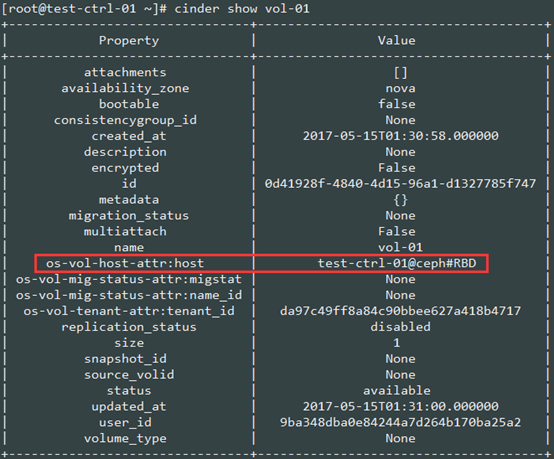
到此,旧版配置格式已经改成新版配置格式,进行步骤3添加另一个ceph后端。 # G$ \. \5 ?) Z
3. 添加一个ceph后端 将新的ceph集群的配置文件复制到所有openstack节点(包括控制节点和计算节点)。 注意:不同ceph集群依靠配置文件的名字区分,如:已有ceph集群的配置文件为/etc/ceph/ceph.conf,如果新集群全用SAS盘,配置文件可以命名为:/etc/ceph/ceph-sas.conf。 然后编辑/etc/cinder/cinder.conf,添加新的ceph backend,编辑完后的相关配置如下: [DEFAULT]enabled_backends = ceph,ceph-new[ceph]rbd_pool = volumesrbd_ceph_conf = /etc/ceph/ceph.confrbd_flatten_volume_from_snapshot = truerbd_max_clone_depth = 5rbd_store_chunk_size = 4rados_connect_timeout = -1glance_api_version = 2volume_backend_name=cephvolume_driver = cinder.volume.drivers.rbd.RBDDriver[ceph-new]rbd_pool = volumesrbd_ceph_conf = /etc/ceph/ceph-new.confrbd_flatten_volume_from_snapshot = truerbd_max_clone_depth = 5rbd_store_chunk_size = 4rados_connect_timeout = -1glance_api_version = 2volume_backend_name=ceph-newvolume_driver = cinder.volume.drivers.rbd.RBDDriver; ^% i J6 F! K6 Y1 @- ^
重启cinder-volume服务: # service cinder-volume restart # 对于Ubuntu 14.04# systemctl restart openstack-cinder-volume # 对于CentOS 7/ Q9 R' Q! {1 j5 X
执行cinder service-list命令,可以看到每个后端对应一个cinder-volume服务: 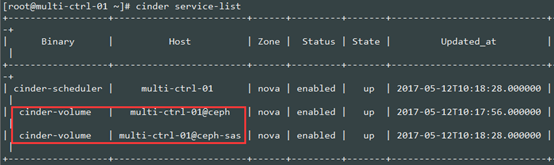
9 T# V* Z) f# E/ F) D4. 配置volume-type 对于每个ceph后端,创建一个volume type,并将volume type关联配置文件中的volume_backend_name: # cinder type-create ceph1# cinder type-key ceph set volume_backend_name=ceph1# cinder type-create ceph-new# cinder type-key ceph-new set volume_backend_name=ceph-new
. Q: f- v$ \$ O+ u然后执行cinder type-list可以看到配置的volume type: 
( }4 h) U9 B% y6 l' \2 ~* P- ~
5. 创建卷 此后创建卷时,可以指定volume type,将卷创建到指定的ceph后端: # cinder create 30 --name vol-01 --volume-type ceph-new
3 r+ l1 \ ]( H1 X前端也可选则volume type: 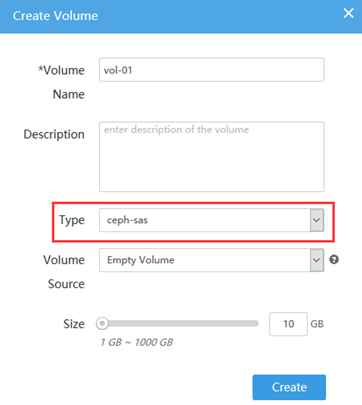
注:如果不指定volume type,cinder-scheduler会忽略volume type,按默认的调度器从所有cinder-volume调度。 ) D! Q3 o3 a0 j& n. W S
|





 发表于 2021-2-5 08:00:08